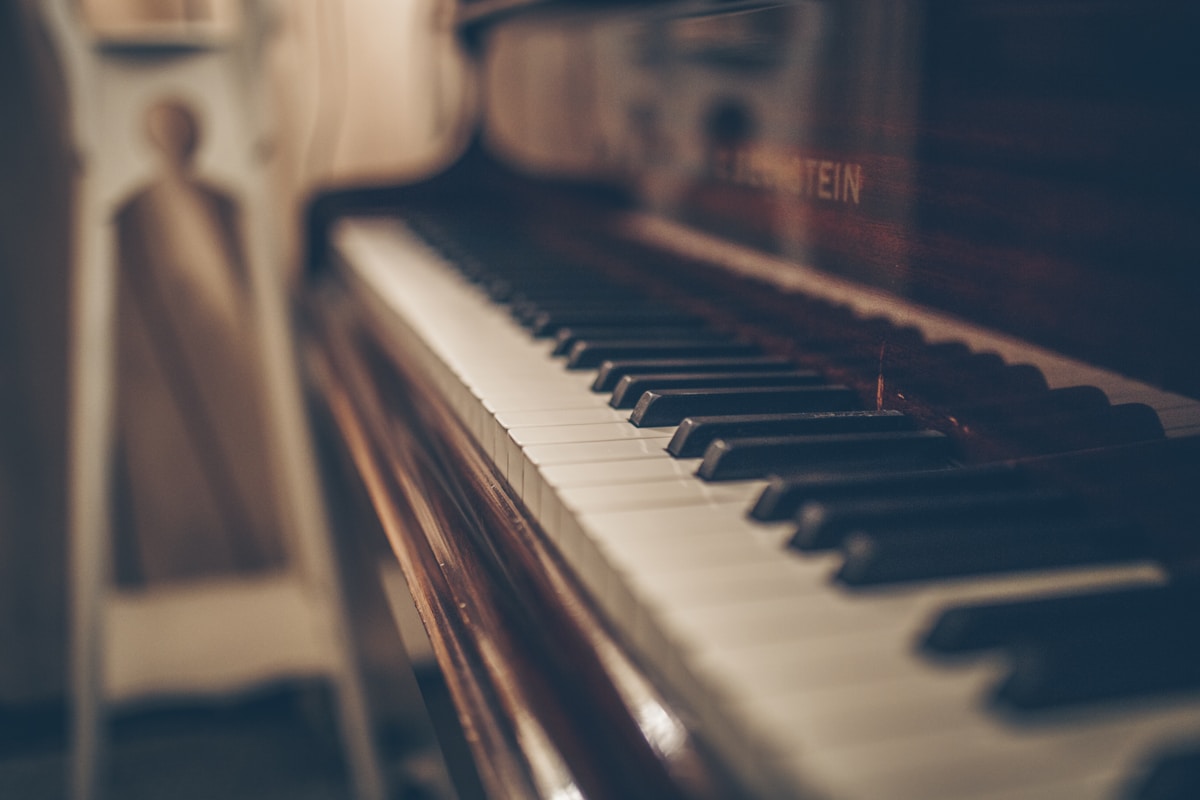
1. Pre-Jazz & Ragtime (1890s-1910s)
Historical Context
Before jazz had a name, American music was undergoing a transformation. In the late 19th century, African American musicians were synthesizing African rhythmic traditions with European harmonic and formal structures. This fusion happened across the South, but particularly in cities like New Orleans, St. Louis, and Sedalia, Missouri.
Ragtime emerged in the 1890s, primarily as composed piano music. Published as sheet music and played in saloons, theaters, and homes, ragtime was wildly popular—America’s first homegrown popular music to achieve international recognition. Scott Joplin called it “ragged time” referring to its syncopated rhythms that seemed to “rag” (upset) the regular meter.
The era coincided with:
- Post-Reconstruction racial segregation (Jim Crow laws)
- The rise of vaudeville and minstrel shows
- Piano manufacturing boom making instruments more accessible
- Tin Pan Alley’s development as music publishing center
Relationship to Earlier Styles
Ragtime synthesized multiple traditions:
From African American Music:
- Syncopated rhythms from banjo playing and African drumming traditions
- Call-and-response patterns
- Percussive approach to piano
From European Classical Music:
- March forms (particularly John Philip Sousa’s marches)
- Formal compositional structures
- Harmonic language of romantic-era classical music
- Written notation and composition
From Popular Song:
- Melodic accessibility
- Song forms (verse/chorus structures)
- Dance rhythms (cakewalk, two-step)
Ragtime was composed rather than improvised, distinguishing it from the jazz that would follow. But it established the rhythmic foundation jazz would build upon.
Musical Characteristics
Syncopation (Theory Introduction)
The defining characteristic of ragtime is syncopation—placing rhythmic emphasis on weak beats or offbeats. On piano, the left hand maintains a steady “oom-pah” or march-like bass pattern in duple meter (usually 2/4), while the right hand plays syncopated melodies that accent unexpected beats.
This creates a delightful tension: the pianist’s left hand stays “straight” while the right hand “rags” the rhythm. Example: where you’d expect emphasis on beats 1 and 3, ragtime melodies accent the “and” of 1 and beat 2.
Form
Ragtime pieces typically use multi-strain form borrowed from marches:
- Usually 3-4 distinct melodic sections (strains)
- Each strain typically 16 bars
- Pattern like: AA BB A CC DD
- Key changes between sections (often to subdominant)
- Each strain repeated
Stride Piano (Theory Introduction)
Stride piano evolved from ragtime’s left-hand patterns. The pianist’s left hand “strides” between:
- Low bass notes or octaves on beats 1 and 3
- Mid-range chords on beats 2 and 4
This creates a strong, propulsive rhythm and fuller harmonic texture than earlier ragtime.
Harmony
- Primarily diatonic (staying within major/minor keys)
- Standard classical progressions (I-IV-V-I)
- Some chromaticism for color
- Secondary dominants for modulation between strains
- Simpler than jazz harmony that would follow
Melody
- Highly syncopated but clearly structured
- Scalar passages and arpeggios
- Ornamented with grace notes and turns
- Designed to sound difficult but be playable
- Vocal quality despite being instrumental
Key Musicians
Scott Joplin (1868-1917) - Piano/Composer The “King of Ragtime.” Composed sophisticated, refined ragtime and fought to have it recognized as serious artistic music. His works elevated ragtime from popular entertainment to art music.
James Scott (1885-1938) - Piano/Composer
One of the “Big Three” ragtime composers alongside Joplin and Joseph Lamb. Known for sophisticated harmonic progressions and melodic development.
Joseph Lamb (1887-1960) - Piano/Composer The third of the “Big Three.” White composer who studied Joplin’s work closely. Known for complex, refined compositions.
Jelly Roll Morton (1890-1941) - Piano/Composer Claimed to have “invented jazz in 1902.” Bridged ragtime and early jazz, adding improvisation and blues feeling to ragtime structures. His work points toward what was coming.
Eubie Blake (1887-1983) - Piano/Composer Stride pianist who extended ragtime’s life into the 1920s. Known for “I’m Just Wild About Harry” and other songs that brought ragtime sensibility to popular song.
James P. Johnson (1894-1955) - Piano “Father of Stride Piano.” Developed stride technique that would influence every jazz pianist after him. Composed “The Charleston.”
Essential Recordings
- “Maple Leaf Rag” - Scott Joplin (1899) - The piece that defined ragtime, still the most famous rag ever written
Spotify - “The Entertainer” - Scott Joplin (1902) - Perfectly balanced melody and rhythm; later featured in “The Sting”
Spotify - “Frog Legs Rag” - James Scott (1906) - Showcases sophisticated harmony and structure
Spotify - “Solace” - Scott Joplin (1909) - Lyrical, slower “Mexican serenade” showing ragtime’s expressive range
Spotify - “Ragtime Dance” - Scott Joplin (1902) - Demonstrates connection between ragtime and dance
Spotify - “Sensation Rag” - Joseph Lamb (1908) - Complex composition showing ragtime’s artistic maturity
Spotify - “Joplin’s Maple Leaf Rag” - Jelly Roll Morton (1938) - Morton’s improvised version shows the bridge to jazz
Spotify - “Carolina Shout” - James P. Johnson (1921) - Stride piano at its finest, test piece for aspiring pianists
Spotify
Note: Many ragtime pieces were originally published as sheet music. Modern recordings feature various pianists interpreting these compositions.
Cultural Impact
- First distinctly American music to gain international recognition
- Challenged European dominance in serious music
- Created controversy (condemned by some as primitive, celebrated by others as innovative)
- Influenced European classical composers (Debussy, Stravinsky)
- Established piano as central to American popular music
- Created template for syncopation that jazz would expand
- Demonstrated African American musical sophistication during Jim Crow era
The Bridge to Jazz
While ragtime was primarily composed music played from written scores, it contained seeds of jazz:
- Syncopated rhythms that would become swing
- Pianistic techniques (stride) that jazz would adopt
- Blues-inflected melodies
- Individual expression within composed frameworks
By the 1910s, musicians in New Orleans were taking ragtime’s rhythmic innovations and adding something new: collective improvisation. The jazz age was beginning.
| Navigation: ← Introduction | Next: Chapter 2 - New Orleans Jazz → |